




Essential Tips for Maximizing Ambience and Maintaining Clarity
Lush ambient swells and swirling, undulating reverb seem to last forever, transporting you into the halls of a glorious throne room where you are greeted by a chorus of angelic shimmers. Reverb is an integral component of modern-day worship music; it is nearly impossible to imagine or hear a song without it. Reverb pedals such as the Strymon Bigsky, GFI Specular Tempus, JET Pedals Revelation Reverb, Neunaber Immerse, Empress Reverb, and Eventide H9 have become staples on worship guitar pedalboards due to their rich, spacious, textured soundscapes.
I’m not saying that you absolutely need one (or all) of these pedals to play worship guitar. However, if you don’t already have a reverb pedal, I highly recommend checking out any of the pedals listed above. They are some of the best reverb pedals I’ve heard, and they will all get you “that sound” for worship music.
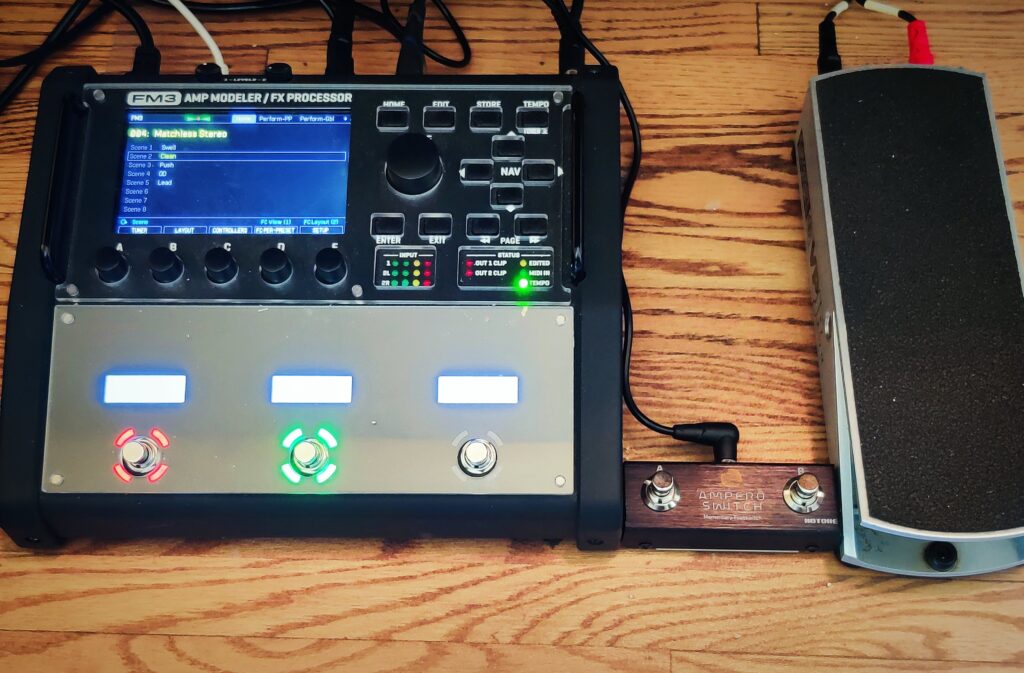
But, if you already have a full-fledged pedalboard or an all-in-one modeler like the Fractal Audio FM3 (my personal choice) or a Line6 Helix, and you’re not getting the sounds you want out of your reverb, before buying more gear, I want to offer some tips to try first before giving up and speed dialing your Sweetwater rep.
I was in the same situation with my FM3. The FM3 has some great sounding reverb algorithms, but I wasn’t getting the thick, enveloping reverbs I was hearing from other reverb pedals. Since the FM3 is limited to only one reverb block, I thought the solution would be to get a separate reverb pedal to stack reverbs together for glorious ambience. However, my birthday was still half a year away, and I didn’t have any gear I could sell. Instead of trying to explain to my wife why I needed to spend $250-300 on another guitar pedal, I decided to go back to the drawing board and tweak some parameters to get as close to the sound I was hearing in my head.
To my delight, and I’m sure to my wife’s relief if she were aware of the voodoo economic theories I was running in my mind to justify my next pedal purchase, I was able to dial in some worthy reverb tones. I want to share those tips for those who may be facing a similar dilemma.
1. Choose a reverb algorithm that emulates a large space.
Imagine walking into a medieval European cathedral with long hallways and towering ceilings. The sound of your footsteps bounces off every marbled surface and blooms into a dense, encapsulating drone. That is the kind of space we want to create with our reverb pedal. Cloud reverbs like the Cirroculumus, Nimbostratus, and Stratocumulus are my go-to options on the FM3. However, a large hall, church, or space algorithm will also work. Smaller reverbs like spring, plate, and room won’t be as effective.
2. Increase Decay Time, Size, and Mix
All reverb pedals have these controls, though they may be labeled differently. Decay time refers to how long the sound lingers after you stop playing. In my most commonly used presets, the reverb decay times range between 10-20 seconds. Size refers to how wide the space is that the sound bounces around in. A small space would be like a bedroom, while a large space would be like a gymnasium. Finally, the mix determines how much of the reverb sound blends in with your dry guitar tone. It may be tempting to turn everything up all the way to create maximum space and volume. Depending on your pedal and overall signal chain, this may work, but it could also make the sound too muddy or thin, lacking definition.
3. Add a delay after the reverb
Now comes the fun part. In my setup, having a standalone reverb at the end of my signal chain didn’t sound bad, but the reverb was just lingering and not creating any movement to add to the sound. By adding a delay pedal after the reverb, it modulates the reverb tails and creates a swirling, ebbing, and flowing effect that makes the sound denser and more interesting. In this preset, I have a dual delay with the mix and feedback set to around 40%. This delay would be in addition to your delay pedal for your dry guitar tone for guitar line repeats. As this one would be affecting just your reverb, you would need at least two delay pedals in your signal chain.
4. Add a chorus after the delay
The fun doesn’t stop after the delay! For even thicker, creamier reverb goodness, add a chorus pedal after the delay. This will create even more modulation to your reverb decay, resulting in more stereo width and additional voices that add more body to the reverb and fill up more space.
5. Experiment with Other Modulation Effects
If you’ve got pedals or CPU processing power to spare, try experimenting with other modulation effects added after the reverb chain. Add a flanger or phaser for a swooshing effect, a pitch pedal to add shimmer or sub-shimmer (or both!), or tremolo for more back and forth motion, from subtle movements to seasick-inducing. The possibilities are endless!
Key Tips for Retaining Clarity
Now you’ve got a big, lush sounding reverb - congrats! But the issue you’re now facing is that everything sounds muddy, and your notes are disintegrating into one jumbled space cloud. Here is what to do so that you can keep both a big reverb and a clear tone.
1. Increase the pre-delay time
The pre-delay time is different from the decay time. Pre-delay is how long after you hit a note that the reverb kicks in. Increasing the pre-delay time allows you to get a head start on your playing, so to speak, so that your notes ring out clearly before the reverb activates.
2. Lower the Ducking Threshold
Not all reverb pedals have this option, but if yours does, make use of it. The ducking threshold determines how quiet your playing volume needs to be before the reverb is allowed to be at full volume. This means that while you’re playing, the volume of the reverb is decreased so that it doesn’t compete with what you’re playing and then gets louder once you’ve stopped playing to fill the space. A lower threshold means the reverb will stay quieter longer until the volume of your last note played trails off below that threshold.
3. Run your Reverb in Parallel with Your Delay
This one is huge, and for my rig, it’s the most important factor in retaining clarity with big reverbs. When you’re running delay and reverb in series, with the delay running into the reverb, the delay repeats keep hitting the reverb, causing the repeated notes to lose definition and disappear into the ether of your reverb cloud. To avoid this, I create two signal paths, with one going through the delay, and another one that takes everything before the delay and goes through the reverb. The two signals then converge right before the output. This allows the delay repeats to feedback clearly without being affected by the reverb, and also lets you to crank up the reverb mix and volume since you don’t run the risk of having your entire signal path sound muddy. You essentially have a “dry” rig that bypasses the reverb and keeps your signal clear, and a “wet” rig that is 100% processed by the reverb.
4. Use scenes/snapshots with different reverb parameters
If you’ve been using some type of multi-fx unit like the Fractal or Helix products, then you no doubt are familiar with scenes. Scenes allow you to turn on/off effects and recall saved parameters of each individual effect with a push of a foot switch. This is extremely helpful to transition between different parts of a song - from a quiet breakdown chorus with lots of ambience to a raucous intro with a prominent electric lead line, for example - without having to bend down and adjust any settings. When setting up your scenes, don’t ignore the reverb parameters, especially the mix and the decay time. Depending on the song, you may not want a big spacious reverb throughout the entire song. On the quieter parts, turn up the mix and the decay to let the reverb trails fill in the space between the notes. On parts that involve lots of strumming over big chords, dial the mix and decay back so that the rhythm and attack of your playing cuts through the mix and provides a lift to the song.
Remember to have fun and experiment, but most importantly, ensure that both your playing and pedalboard serve the song, leading the congregation to praise and worship the one true King of kings.
Fractal Audio FM3 Reverb Sound Samples
Shop this Article
Find amazing deals on the Fractal Audio FM3 on Reverb.com.